Printed clothing for freezers and cold stores – how to combine functionality with corporate identity?
Employees in warehouses, food processing plants, and logistics centers spend up to several hours a day in temperatures reaching -30°C or lower. They need clothing that effectively protects against hypothermia, but something else becomes equally important – the employer's visual identity. A logo on the chest, the company name on the back, corporate colors. How can you combine them without losing safety certifications? It turns out that it doesn't have to be an "either-or" choice. The right decoration technique and thoughtful print placement allow you to maintain both protection and branding. In this article, we show you how to do it safely and permanently.
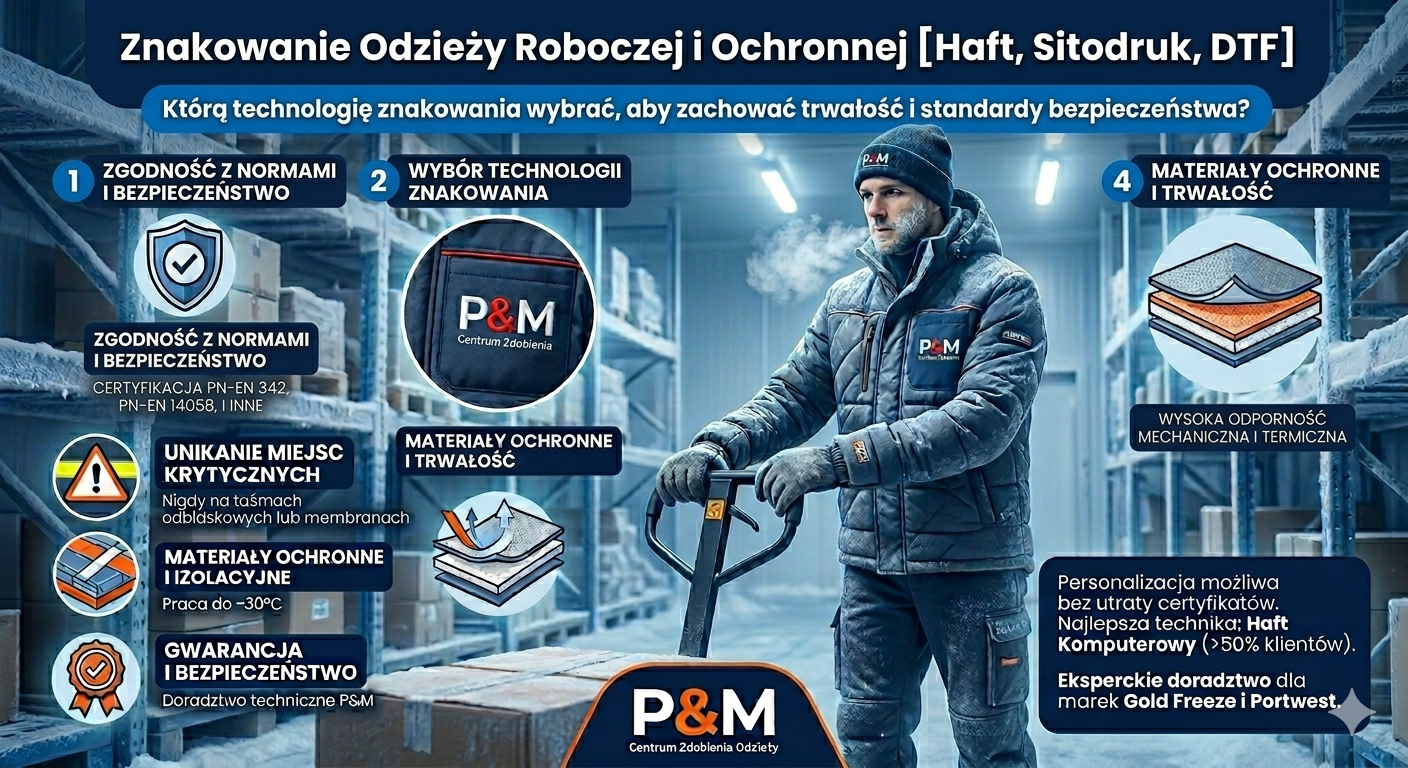
TL;DR Personalization of clothing for freezers and cold stores (PN-EN 342 and PN-EN 14058 standards) is fully possible provided that the appropriate decoration technique is used – preferably computer embroidery on the outer panels. Over 50% of customers choose embroidery due to its durability in washing and freezing. Key: do not print on reflective tapes or membrane elements. DTF and screen printing are suitable for less demanding conditions. P&M offers comprehensive services: from consulting to personalization of clothing from renowned manufacturers (Gold Freeze, Portwest) with delivery to parcel lockers.
Health and safety standards and regulations for freezer clothing – what you need to know before printing
Before deciding which technique to use to decorate clothing for freezer workers, you need to understand the standards you're dealing with. Protective clothing for working in cold environments is not just a jacket – it's Category II personal protective equipment (PPE), subject to stringent legal requirements.
Standards that matter:
- PN-EN 342 – protection against cold at temperatures below -5°C. This is a key standard for freezer clothing. Specifies minimum thermal resistance values (Rct ≥ 0.310 m²K/W) and air permeability requirements.
- PN-EN 14058 – protection against cold at temperatures from -5°C to above 0°C. Category I equipment, used in cold stores and rooms with moderately low temperatures.
- PN-EN 343 – protection against rain and wind (watertightness, breathability).
- PN-EN ISO 20471 – high-visibility warning clothing (classes 1–3, depending on the surface of fluorescent and reflective materials).
Legal basis: Regulation (EU) 2016/425 of the European Parliament and of the Council on PPE applies within the EU. In Poland, employers are required to provide protective clothing compliant with standards based on the Regulation of the Minister of Labor and Social Policy of 26 September 1997 (Journal of Laws 1997, No. 129, item 844).
Differences between clothing for cold stores (EN 14058) and freezers (EN 342)
The practical difference comes down to the temperature range and PPE category:
| Parameter |
Cold store (EN 14058) |
Freezer (EN 342) |
| Temperature range |
≥ -5°C |
≤ -5°C (even down to -60°C) |
| PPE Category |
I (low risk) |
II (medium risk) |
| Rct Requirement |
no minimum |
≥ 0.310 m²K/W |
| Examples |
food cold stores, warehouses |
freezing tunnels, deep-frozen stores |
Where Should I place a print? Regardless of the standard, logos and graphic elements should be outside the area of reflective tapes and membrane panels. In the case of EN 342 clothing, printing in a key area for insulation (e.g., on the back in the area of the main insulation layer) does not affect RCT parameters, provided it does not disturb the fabric structure – hence the choice of decoration technique is critical.
Personalization of protective clothing – which decoration techniques will work in a freezer?
Not every printing method is suitable for clothing working in sub-zero temperatures and subjected to frequent industrial washing. Below is a comparison of four techniques available at P&M Clothing Decorating Center.
| Technique |
Frost resistance |
Washing resistance |
Risk of membrane damage |
Recommended area |
Relative cost |
| Computer embroidery |
Very high |
High (up to 50+ washes) |
Low (with embroidery on the outer panel) |
Breast, back, sleeve (without membranes) |
Medium |
| DTF (Direct to Film) |
Medium |
Medium (approx. 20–25 washes) |
Very low |
Flat, unstructured areas |
Low |
| Screen printing |
High |
High (approx. 30–40 washes) |
Low |
Large flat areas |
Higher for small print runs |
| DTG (Direct to Garment) |
Low |
Low (approx. 10-15 washes) |
Very low |
Cotton – rarely found in freezers |
Medium |
Why computer embroidery is the best choice for freezers
P&M's many years of experience show that over 50% of customers choose computer embroidery for marking workwear for low temperatures. The reason is simple – embroidery is the most durable.
- Abrasion and frost resistance – the multi-layer thread structure (polyester) does not crack at low temperatures or fade after washing.
- Durability in industrial washing – embroidery remains legible even after 50 cycles, while thermal transfer prints begin to peel after just 20.
- Professional appearance – the raised, three-dimensional effect of embroidery increases the perceived value of the garment.
One risk: Embroidery may damage the waterproof or vapor-permeable membrane (e.g., in EN 343 clothing). The solution? Only use embroidery on the outer panels of the fabric – never in places where the needle could penetrate the insulating layer. P&M, with its own embroidery shop (since 2008), precisely selects the location and density of the embroidery to avoid compromising certification.
DTF and screen printing – when to consider them?
- DTF – works well for multi-color, complex graphics (e.g., photorealistic logos). It is cheaper for small runs, but less abrasion-resistant. A good choice for cold-storage clothing (EN 14058), where protective requirements are lower.
- Screen printing – great for large, single-color surfaces (company name on the back). Durable, but creates a surface layer that can harden in extreme cold. It works well in cold stores, but embroidery is better for freezers.
What to look for: When choosing a decoration technique, always check whether the clothing manufacturer allows personalization without voiding the warranty. For EN 342-certified clothing (Gold Freeze, Portwest), methods that do not damage the fabric structure are recommended – embroidery on external panels or sublimation (for polyester substrates).
Safety and branding – how to combine a logo with thermal protection?
Branding on workwear is not just a marketing issue. It's also a visual identification element in the field – your name and surname on the chest, logo on the back, or department designation on the sleeve help with communication and safety management.
Safe and prohibited zones for printing
Permitted zones:
- Left or right side of the chest (below the lapel, above the first pocket)
- Center of the back (above the waistline)
- Outer part of the sleeve (above the elbow)
- Inside collar (e.g., name tag)
Prohibited zones:
- Reflective tapes (must not be covered according to EN ISO 20471)
- Areas with a breathable membrane (e.g., underarms, inner panels)
- Main seams and structural elements of the garment
- Areas exposed to direct friction (elbows, cuffs)
Integration with reflective elements
In garments meeting the EN ISO 20471 standard (e.g., Portwest CS-12), reflective tapes are placed in specific locations: circumferentially around the torso and sleeves. They must not be covered by the logo – this would reduce the reflective surface and lower the visibility class. The solution? Place a logo on the chest (between the reflective tapes) or opt for embroidery in the color of the reflective tape – this is a fashionable trend used by logistics operators.
Examples from the P&M offer – clothing for freezers and cold stores with protection and branding
P&M Clothing Decoration Center has been combining the functionality of protective clothing with personalization for 25 years. The company offers products that meet even the most stringent standards, with the option of printing or embroidery – see the full category freezer and cold store clothing to see the available models.
Gold Freeze – protection up to -83.3°C (Hi-Glo 40 Xtreme Deep)
Gold Freeze is a British manufacturer specializing in clothing for extremely low temperatures. P&M offers:
- Gold Freeze Hi-Glo 40 Xtreme Deep – protection up to -83.3°C (EN 342 certified). One-piece coverall with 3M Thinsulate insulation, built-in reflective tapes and fluorescent material. Perfect for working in freezing tunnels in the food industry.
- Gold Freeze Hi-Glo 25 – protection down to -64.2°C – a lighter version, suitable for colder temperatures.
Customization: For Gold Freeze clothing, P&M recommends computer embroidery on the chest (in the area between the reflective tapes) – durable, non-interfering with reflective elements, resistant to industrial washing.
Portwest CS-12 – multifunctional coverall (EN 342 + EN 343 + EN ISO 20471)
Portwest CS-12 from the ColdStore line is a coverall that meets three standards simultaneously:
- EN 342 - protection down to -58°C
EN 343 - waterproof and breathable
EN ISO 20471 - Class 3 high-visibility clothing
ul>
Personalization:
Thanks to the large, flat back and chest area (free of reflective tape), the coverall is perfect for screen printing (company name on the back) or computer embroidery (logo on the chest). P&M offers a comprehensive service - from size selection (S-4XL) to decoration.
hr />
h2>Summary
p>Personalizing your clothing for freezers and cold stores doesn't have to mean sacrificing safety. Three elements are key:
- Choosing the decoration technique – computer embroidery is the most durable and safest for certified clothing. DTF and screen printing as complementary options in less demanding conditions.
- Print location – only in safe areas (chest, back, outer sleeve), away from reflective tapes and membranes.
- Collaboration with a partner who understands the standards – a company like P&M (with 30 years of experience, its own sewing and embroidery facility) guarantees that every element of personalization complies with PPE requirements.
The popularity of multifunctional clothing (EN 342 + EN 343 + EN ISO 20471), the growing importance of sustainable materials and innovative insulation (3M Thinsulate, CLIMASCOT) – these are the trends that will shape the cold weather clothing market in 2025–2026. One thing remains unchanged: the need for a clear, durable corporate identity.
Contact our advisor to choose personalized cold store clothing – check out the offer on the P&M website.
FAQ – Frequently Asked Questions
1. Does printing on cold store clothing affect its protective properties? No, provided the printing is done using the appropriate technique and in a safe location. Embroidery on the outer panel does not affect thermal insulation (RCT). It is crucial to avoid reflective tapes and membranes.
2. Can embroidery damage the clothing membrane? Yes, if the needle penetrates the membrane layer. Therefore, embroidery should only be used on outer clothing panels, away from waterproof areas. P&M selects embroidery density and placement to minimize this risk.
3. Which decoration technique is most durable in freezing conditions? Computer embroidery – withstands up to 50+ industrial washes, does not crack in the cold, and does not fade. It is chosen by over 50% of P&M customers.
4. Can I apply a logo to clothing with reflective tape? No. Reflective tapes cannot be obscured – this would reduce the visibility class according to EN ISO 20471. The logo is placed between the tapes, on the chest or back.
5. What sizes are available for personalized frozen food clothing? P&M offers sizes from S to 4XL (in selected models). The company also processes orders from state and local government institutions.
6. How long does it take to process an order for printed clothing? The processing time depends on the technique and quantity. For computer embroidery, the standard delivery time is 5-10 business days. P&M offers free delivery from PLN 1,000 gross (including to InPost parcel lockers).
7. Does P&M have experience decorating clothing for large companies? Yes. The company has been serving corporate clients from Poland and Europe (Germany, the Netherlands, Belgium, France) for 25 years. It has a rating of 5.0/5.0 on Google (172 reviews) and 4.8/5.0 on pkt.pl (26 reviews).
Sources
- PN-EN 342:2017-05 – Protective clothing – Clothing assemblies and clothing providing protection against cold (Polish Committee for Standardization)
- PN-EN 14058:2017-05 – Protective clothing – Clothing providing protection against cold (Polish Committee for Standardization)
- Regulation (EU) 2016/425 of the European Parliament and of the Council of 9 March 2016 on personal protective equipment (Official Journal of the EU)
- Regulation of the Minister of Labour and Social Policy of September 26, 1997, on general occupational health and safety regulations (Journal of Laws 1997, No. 129, item 844)
- P&M Clothing Decoration Center offer – clothing for freezers and cold stores (pimcos.pl)
- P&M customer reviews – Google Business Profile (5.0/5.0, 172 reviews) and pkt.pl (4.8/5.0, 26 reviews)
Comments (0)