How to distinguish your restaurant from the competition and attract more guests
The Polish restaurant market now has over 100,000 locations and is worth over PLN 76 billion. In this dense network of establishments, good food alone is no longer enough to make guests choose your establishment. Success is increasingly determined by a coherent brand, a well-thought-out atmosphere, and a professional image – including the visual identity of the staff, which remains an undervalued tool for building a competitive advantage.
TL;DR The Polish restaurant market has over 100,000 establishments worth PLN 76.7 billion – competition is fierce, and 86% of restaurateurs don't know how to effectively increase revenue. Research shows that 78% of guests are willing to pay more for a unique experience, and 74% choose a restaurant based on social media. In this article, you'll find specific strategies for differentiating your restaurant – from defining your USP, through atmosphere and social media, to visual identification of your staff, which is one of the most effective yet overlooked branding tools.
How to make your restaurant stand out from the competition – key data on the Polish restaurant market
Before you get started, it's worth understanding the scale of the challenge. Here are five numbers that define today's Polish restaurant market:
Over 100,000 restaurant locations. According to data from the Central Statistical Office (GUS) and a report by PMR Market Experts, in June 2025 the number of restaurants in Poland will exceed 100,000, representing a 4.2% year-on-year increase. There is one restaurant for every 380 residents.
PLN 76.7 billion – this is the revenue of the restaurant industry in 2023, and the growth rate in 2023–2025 is maintained at 8–9% annually (data from POSbistro, Central Statistical Office). The market is growing, but so is the number of players vying for the same guest.
PLN 64.18 – the average bill in January 2025 (an increase of 13–21% compared to 2023). In small establishments with a single location, the average reaches PLN 72.12. This means guests are spending more, but they are also more demanding.
86% of restaurateurs don't know how to increase revenue. The POSbistro report "Top Challenges of Polish Restaurateurs 2024" indicates that the vast majority of restaurant owners lack a growth strategy, and 68% cite high costs as their main challenge.
It costs 5-7 times more to acquire a new guest than to retain a regular one. This is a general marketing principle that is particularly true in the restaurant industry – a loyal customer is every restaurant's most valuable asset.
The conclusion is simple: good food alone is not enough. You need a coherent differentiation strategy that encompasses both what you serve and how the market perceives you.
Unique Value Proposition (USP) – the foundation of restaurant differentiation
A unique value proposition, or USP (Unique Selling Proposition), answers the question of why a guest should choose your establishment over a competing one. In the restaurant industry, a USP isn't an advertising slogan – it's a specific, verifiable feature that no one else in the area offers.
How to define a USP in three steps:
Step 1: Define your ideal guest profile. Are you targeting families with children looking for a relaxed atmosphere and a play area? Business people looking for a quick, comfortable lunch? Young adults who come for the atmosphere and Instagram photos? The guest profile determines not only the menu, but also the décor, music, and even the style of social media communication.
Step 2: Identify what's missing in the area. Walk around competing establishments within a kilometer radius. What don't they offer? It could be an open kitchen, dishes made with local ingredients within a 50-kilometer radius, a tasting menu, a wine list from small vineyards, or maybe just a place to work with your laptop during the day.
Step 3: Formulate your USP in one sentence. "The only restaurant in the district with an open kitchen and a weekly changing seasonal menu." "All dishes prepared with ingredients from suppliers within a 50-kilometer radius." "The largest selection of natural wines in the city with fusion cuisine."
A trap to avoid: trying to be everything to everyone. A restaurant that combines pizza, sushi, burgers, and steaks on its menu won't be memorable. Specialization isn't a limitation—it's your greatest marketing asset.
Atmosphere and decor—why guests are willing to pay more
A restaurant's atmosphere isn't a "nice-to-have"—it's a business decision with a measurable return. The MADE FOR RESTAURANT 2024/2025 report (ARC Rynek i Opinia, N=1005) shows that 78% of guests care about the atmosphere, and 42% are willing to pay more for unique decor. Furthermore, 60% will pay extra for higher quality food, and 46% for excellent service—but it's the atmosphere that often determines the first impression.
A scientific study by Rathnasiri et al. (2025, PLOS ONE, N=440) provides even more precise data: sanitation (cleanliness and hygiene, β=0.337) and the menu (β=0.322) are the strongest predictors of guest satisfaction and their intention to return. Cleanliness is not just about the kitchen and restrooms – it also includes the neat, well-groomed appearance of the staff.
Five elements of atmosphere that directly influence guest decisions:
- Lighting – too bright discourages evening visits, too dark makes it difficult to read the menu. Adjusting the light intensity during the day is standard.
- Music – appropriately selected for the time of day and guest profile. Loud music during lunchtime can discourage business guests.
- Cleanliness and hygiene – the strongest predictor of satisfaction. This applies to both the room and the restrooms, as well as the appearance of the staff.
- Temperature and ventilation – too cold or too stuffy is one of the most common reasons for leaving the premises prematurely.
- Visual consistency – from the color of the walls, through the tableware, to staff clothing. Each element should play in the same tone.
The appearance of the staff is a separate element of the atmosphere – more on this in the next section.
Staff visual identification – an underrated tool for building a restaurant brand
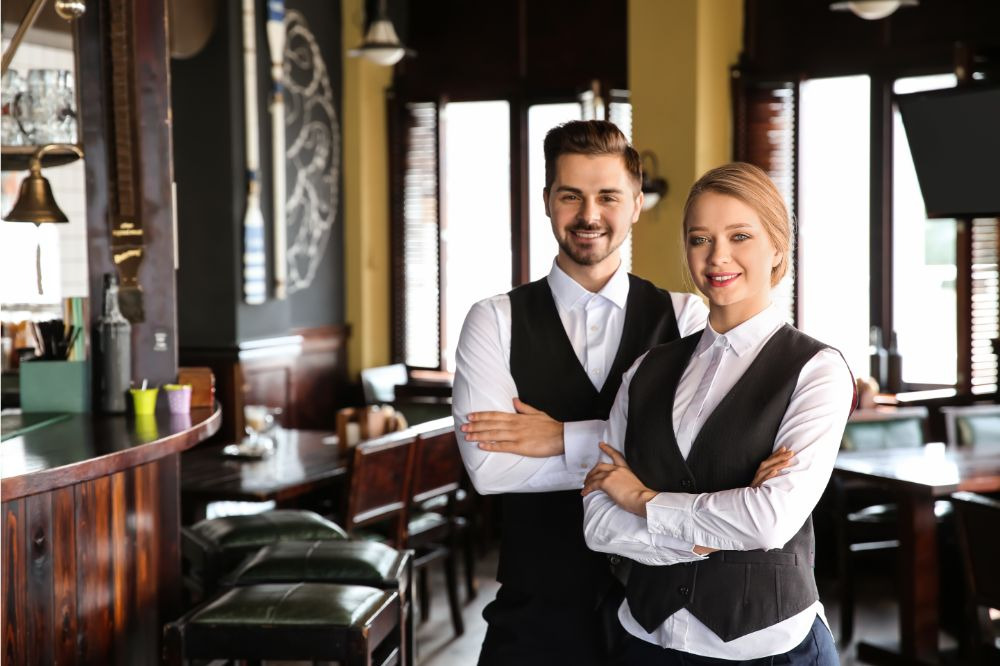
In Polish gastronomy, staff clothing is still rarely considered an element of a marketing strategy. Meanwhile, a mechanism known in psychology as the halo effect is at work here: a neat, professional staff uniform makes guests rate the quality of food, the competence of the staff and the overall standard of the establishment higher. Industry research (KomisGastronomiczny.pl, 2026) confirms that staff uniforms are a precise marketing communication tool – they communicate hygiene standards, professionalism, and commitment to the concept.
Trends in catering clothing for 2025:
- Minimalism and subdued colors – black, graphite, olive, and navy blue replace traditional white, which gets dirty quickly and requires frequent replacement.
- Personalization as standard – the restaurant's logo, employee name, and even the brand slogan on clothing are no longer an addition, but a guest expectation.
- Eco-friendly and functional materials – organic cotton, blends with elastane for freedom of movement and breathability.
Embroidery or print – what to choose for gastronomy?
| Feature |
Embroidery |
Print (DTF/DTG) |
| Durability |
50+ washes at high temperatures |
approx. 20–25 washes |
| Wash fastness |
Very high – does not fade, does not crack |
Good, but may fade with intensive washing |
| Visual effect |
Elegant, premium, three-dimensional |
Full-color, any graphics, photorealistic |
| Cost |
Higher for small quantities, profitable from 1 piece. |
Lower for small quantities, no flat fee |
| Recommended Application |
Aprons, aprons, tunics – intensively washed clothing |
T-shirts, hats – items with colorful graphics |
In the catering industry, where clothing is washed at high temperatures even dozens of times a month, embroidery is the recommended method as the most durable. This premium solution builds a professional brand image with every staff change and every guest interaction.
P&M Centrum Zdobienia Odzieży has specialized in the production and personalization of corporate apparel for over 30 years, including a dedicated "Gastronomy / SPA" category with 22 products – from aprons and aprons to women's tunics. Thanks to its own sewing and embroidery facility (operating since 2003), it offers comprehensive consulting on the selection of branding techniques, production from just one piece, and the option of combining embroidery with print. This is a proven solution for restaurateurs who treat their staff's image as an investment, not a cost.
Social media and online reviews – how to turn guests into brand ambassadors
Social media is the main gateway to restaurants today. As many as 74% of guests choose a restaurant based on what they see on social media (Restaurant Guide, 2025). According to the MFR 2024/2025 report, 42% learn about restaurants through social media – Facebook (33%), Google Maps (25%), Instagram (15%).
The data on online reviews is even more telling: 97% of consumers check reviews before their first visit, and 68% choose only establishments with a rating of at least 4 stars (BrightLocal, 2026). 46% of diners chose a restaurant based on positive reviews, while 29% decided against it because of negative ones (PYMNTS).
Three types of content that generate the highest engagement:
- People and Behind the Scenes – show the team in action, the preparation process, and the chef at work. This builds authenticity and trust.
- Dining at its Best – professional photos and short videos (Reels, TikTok) of the best-selling dishes.
- Guests at the Restaurant – share customer-generated content (UGC) with permission. This is the most reliable form of promotion.
How to effectively gather reviews:
- Place a QR code leading to your Google profile on tables or on your bill.
- Ask the waiter to make a natural request: "If you enjoyed it, we would appreciate a review on Google."
- Reply to every review – positive ones with thanks, negative ones professionally.
Template for a response to a negative review: "Thank you for your review. We are sorry that your visit did not meet your expectations. We would like to know more details – please contact us at [email] so that we can personally apologize and offer compensation. We value every comment, it helps us improve."
It is worth remembering that in photos posted on social media, the staff in consistent uniforms with logos are an additional, free branding medium. Every photo of a waiter in an embroidered apron is an advertisement for your brand.
Loyalty programs, events, and local SEO – smaller but effective growth levers
These three areas are rarely prioritized, yet they can deliver quick and measurable results. The table below will help you decide where to start:
| Strategy |
Estimated cost |
Time to results |
Impact on traffic |
| Loyalty program (stamp cards) |
Low (from PLN 1/piece) |
1–3 months |
Medium – increases retention by 15–25% |
| Local SEO (Google Maps, reviews) |
Low (time own) |
1–3 months |
High – up to +40% visits from search |
| Themed events (music, quizzes) |
Medium (organization, promotion) |
Immediate |
High – 30–50% increase in traffic on the day of the event |
| Happy hours / seasonal promotions |
Low–medium (margin) |
Immediate |
Medium – controls traffic on slower days |
| Cooperation with local Influencers |
Low-medium (dinner + service) |
1-2 weeks |
Medium-high – reach in a specific group |
Loyalty Programs: Classic stamp cards still work effectively – they're cheap to produce, and guests can physically see their progress toward a reward. Retaining a regular guest is 5-7 times cheaper than acquiring a new one.
Events: Live music, pub quizzes, cooking workshops, themed dinners. Promote them through social media and local Facebook groups. At events, staff wearing consistent clothing with a logo enhances a professional image and creates an additional visual impact in photos.
Local SEO: The three pillars are (1) a complete Google Business Profile with up-to-date hours, photos, and menus, (2) keywords with the name of the city/district ("restaurant [city]", "best pizza [district]"), (3) consistency of NAP data (name, address, phone number) across all websites.
Summary – 5 key takeaways and a 30-day action plan
Five takeaways worth remembering:
- The Polish restaurant market is saturated (100,000+ establishments) – standing out is a necessity, not an option. Good food alone isn't enough.
- Guests are willing to pay more for experiences – 78% will pay extra for a unique atmosphere, 42% for décor. Investing in atmosphere has a measurable return.
- Social media and online reviews are the main channels for acquiring guests – 74% choose a restaurant based on social media, 97% check reviews before visiting.
- Visual identification of staff is one of the most effective, yet still overlooked, branding tools – the halo effect, embroidery durability (50+ washes), visual consistency across the team.
- Retaining a guest is 5-7 times cheaper than acquiring a new one – loyalty programs and excellent service are the cheapest growth strategies.
30-Day Action Plan:
Week 1 – Foundations: Define your restaurant's USP in one sentence. Define your ideal guest profile. Update your online menu and check if it's readable on a smartphone.
Week 2 – Visibility: Complete your Google Business Profile (photos, hours, menu). Ask 10 regular guests for their Google reviews. Create or update your Instagram profile – publish 3 posts featuring your dishes and team.
Week 3 – Image: Invest in consistent staff uniforms with a logo – choose a branding method that matches the clothing (embroidery for aprons and aprons, print for T-shirts). Implement a loyalty program (stamp cards).
Week 4 – Measure and Adjust: Determine which activities resulted in the greatest increase in traffic. Collect feedback from your team and guests. Plan your first themed event for next month.
If you're looking for a proven supplier of embroidery and print catering apparel, P&M Clothing Decorating Center will help you find the perfect solution for your establishment, from single pieces to wholesale orders, with its own sewing and embroidery facility and 30 years of industry experience.
FAQ – Frequently Asked Questions
How much does it cost to acquire a new guest? The cost of acquiring a new guest in the restaurant industry is 5-7 times higher than retaining a regular one. It includes advertising expenses, promotions, welcome discounts, and time spent building online visibility. That's why it's so important to combine new guest acquisition activities with loyalty programs for regulars.
Where to start building a restaurant brand? Start by defining your unique value proposition (USP) and the profile of your ideal guest. Without an answer to the question "why should someone choose us?" any marketing activity will be chaotic. Next, it's worth focusing on three pillars: visibility on Google and social media, consistent visual identity (including staff uniforms), and service quality.
Is it worth investing in staff uniforms with a logo? Yes – it's one of the most profitable investments in building a brand. A uniform with a logo acts as free advertising during every interaction with a guest, builds a professional image, and creates a halo effect (neat staff = higher perceived food quality). Embroidery on catering clothing can withstand 50+ washes at high temperatures, making it a durable and cost-effective solution.
How to quickly see the results of your marketing activities? The quickest way is after the first event or seasonal promotion (immediate effect). Social media activities and Google reviews produce the first results after 1-3 months. Investing in staff clothing and branding has a long-term impact – it builds brand recognition, the value of which increases with each passing month.
Embroidery or Printing – What to Choose for a Restaurant? Embroidery is recommended for clothing that is intensively washed at high temperatures (aprons, aprons, tunics) – it can withstand 50+ washes without losing quality. DTF/DTG printing is better for T-shirts, hats, and items with colorful graphics. It's also possible to combine both methods in a single order.
Comments (0)