Corporate T-shirts with logos – a simple way to create a professional brand image
TL;DR Corporate T-shirts with logos are the cheapest and most effective advertising medium – the cost per impression is approximately 0.02 PLN, and one T-shirt generates over 5,000 brand contacts. The key dilemma: embroidery or printing? In this article, we discuss which technique to choose for specific applications. After reading, you will know how to choose the right model, branding technique, and logo layout to make your company look professional. P&M – a Polish manufacturer with 30+ years of experience and its own sewing and embroidery studio – shows how to do it right.
Corporate T-shirts with logos – why do they work? Data You Should Know
Before choosing the model and technique, it's worth understanding why company t-shirts with logos are one of the best marketing investments you can make. The numbers speak for themselves.
85% of consumers remember a brand after receiving promotional apparel with a logo. This is the highest brand recall rate among all promotional items categories, according to research from the Advertising Specialty Institute (ASI, 2024). What does this mean for you? A customer who receives a t-shirt with your company logo will remember it longer than after seeing an online ad.
One T-shirt generates an average of 5,053 impressions over its lifetime. The cost per impression (CPI) is approximately $0.004 – up to 780 times cheaper than digital ads (ASI Ad Impressions Study). Converted to Polish values: the CPI of a company t-shirt is approximately PLN 0.02. No other advertising channel offers such a low cost of reach.
75% of consumers perceive employees in uniform as more professional and trustworthy. This is according to research by J.D. Power (cited by The Workwear Place). For you, this means one thing: a customer who sees your team in company T-shirts automatically trusts you more.
80% of employees perceive their company more favorably when they receive high-quality company apparel. The HALO Branded Solutions study (2023) shows that branded apparel is not just a marketing tool—it's also an investment in team morale.
73% of employees feel a stronger sense of belonging after receiving branded merchandise (SellersCommerce, 2026). A new employee who receives a company T-shirt on their first day immediately feels part of the team.
87% of people keep promotional products for more than a year (TotalMerchandise, 2025). A T-shirt with a logo doesn't end up in the trash after a week – it works for you for months.
P&M has been helping Polish companies realize this potential for 30 years. As a manufacturer with its own sewing and embroidery facility, you provide clothing that truly builds brand recognition – from the first piece to hundreds.
What do you gain by investing in company T-shirts with a logo?
Professional image and brand recognition
A consistent visual identity for your team is the easiest way to enhance the professionalism of your company. Customers entering your store, office, or production hall immediately know who to approach. No searching, no asking – the staff is clearly marked.
A company T-shirt with a logo acts as a walking advertisement. Employees go out for lunch, take public transportation, shop after work – they showcase your brand every time. With a CPI of PLN 0.02, no banner or advertising spot can compete with such reach.
As a manufacturer with 30 years of experience, P&M advises companies on how to achieve a consistent image – from style selection to precise branding. You don't just sell a T-shirt – you get a complete solution: production, personalization, and distribution in one place. Check out the full range of promotional clothing for companies.
Employer branding – how corporate clothing builds a team
Corporate clothing is more than just external marketing. It's also an employer branding tool that works from the inside out.
HALO research shows that 80% of employees have a better perception of a company that invests in workwear. 73% feel a stronger sense of teamwork (SellersCommerce). The result? Lower turnover, higher engagement, and a better atmosphere.
Onboarding a new employee looks completely different when they receive a company T-shirt on their first day. It sends the message: "You're welcome here, you're part of the team." P&M fulfills orders for teams of both 5 and 500 – each employee receives tailored clothing with a logo that builds a sense of community. See inspiration: office work outfits with a company logo.
Embroidery or print? A comparison of company t-shirt branding techniques
This is the most common question corporate apparel professionals hear. The answer is: it depends. The table below will help you decide.
| Technique |
Durability |
Best use |
Min. Quantity |
Approximate cost |
Limitations |
Availability at P&M |
| Computer embroidery |
Indefinitely (more durable than fabric) |
Polo shirts, sweatshirts – premium corporate clothing |
from 1 piece |
Medium-high |
Limited number of colors, not on thin materials |
✅ Yes |
| DTG (Direct to Garment) |
50+ washes |
Cotton T-shirts, small quantities, photorealism |
from 1 piece |
Low-medium |
Only cotton, slower for large quantities |
✅ Yes |
| DTF (Direct to Film) |
60+ washes |
Any material, small quantities, photorealism, full color |
from 1 pc. |
Low-medium |
Slightly noticeable print texture |
✅ Yes |
| Screen printing |
50+ washes |
Large quantities, simple patterns, solid colors |
from 50 pcs. |
Low (for large (in runs) |
Expensive for small runs, limited number of colors |
✅ Yes |
P&M Recommendations:
- Computer embroidery is the gold standard for corporate apparel. Polo shirts, shirts, and sweatshirts with embroidered logos look prestigious and professional. Embroidery is more durable than fabric – it withstands hundreds of washes without losing quality. P&M has its own embroidery shop (since 2008) and realizes embroidery orders from 1 piece.
- DTF is the best choice for small runs and photorealistic graphics. It works on any material – cotton, polyester, blends. The DTF market is growing by over 40% annually (Printexpress, 2026) and is replacing traditional methods for small and medium-sized print runs.
- Screen printing is cost-effective for orders of 50+ pieces with simple designs. The larger the run, the lower the unit cost. Ideal for events and trade shows where you need a large number of solid-color T-shirts.
- DTG works well for cotton T-shirts with photorealistic designs in small runs.
P&M is one of the few manufacturers to offer all four techniques in one place. You can also combine embroidery and printing on a single piece – for example, an embroidered logo on the chest and a DTF print on the back. This flexibility isn't found with most suppliers.
How to choose a corporate T-shirt? Overview and Recommendations
Choosing a model isn't just about color and price – the material, weight, cut, and how the logo will look on it also matter. The table below will help you choose the model that best suits your needs.
| Model |
Grammage |
Composition |
Recommended technique |
Approximate net price |
Best use |
| Basic T-shirt |
140 g/m² |
100% cotton |
DTG / DTF / screen printing |
from 8 PLN |
Events, trade fairs, large Quantities |
| Premium T-shirt |
190 g/m² |
Combed cotton |
Embroidery / DTG / DTF |
from PLN 15 |
Everyday corporate clothing, service |
| Polo |
180–200 g/m² |
Cotton / piqué |
Embroidery |
from PLN 25 PLN |
Reception, sales, office |
| Sports T-shirt |
140 g/m² |
100% polyester |
DTF / sublimation |
from PLN 12 |
Fitness, outdoor events |
| Longsleeve |
180 g/m² |
Cotton |
DTG / DTF |
from PLN 18 |
Colder months, clothing Work |
Recommendations by industry:
- Reception / Office → Polo with embroidery. Elegant, professional, durable. Embroidery on a polo shirt is standard in companies that care about their image.
- Construction / Service → Premium T-shirt + DTF. Durable combed cotton (190 g/m²) withstands intensive use, and the DTF print is flexible and durable.
- Fitness / Wellness → Polyester sports T-shirt. Breathable, quick-drying, with DTF or sublimation printing.
- Events / trade shows → basic t-shirt + screen printing. Low unit cost for large quantities, simple design, maximum number of pieces within budget.
OEKO-TEX® Standard 100 Certificate – why is it important? 74% of buyers consider the eco-friendliness of promotional items important (ASI Research, 2025). OEKO-TEX-certified clothing guarantees that the material does not contain harmful substances. P&M controls the quality of materials from the source – the sewing room selects only proven fabrics that meet the highest standards. Also check out corporate clothing for demanding industries.
|
|
|
Premium men's white T-shirt Promostars
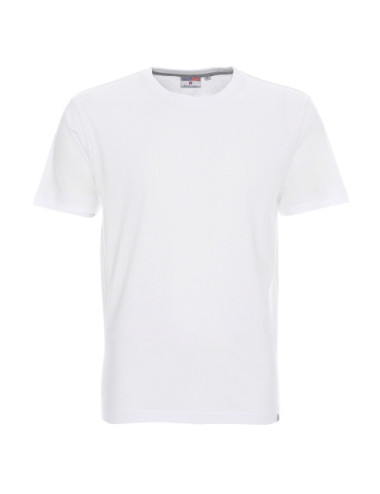
High-quality men's T-shirt made of ring-spun cotton, 190 g/m², ideal for branding your company logo.
PLN 17.79 gross
See product → |
Men's t-shirt TS Ocean t-shirt 145 g wh white JHK
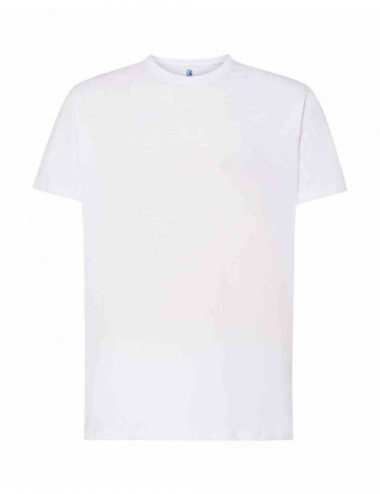
Lightweight men's t-shirt, 100% cotton, 145 g g/m², an excellent base for DTG printing with the company logo.
PLN 10.14 gross
See product → |
Women's basic T-shirt 134 white Adler Malfini
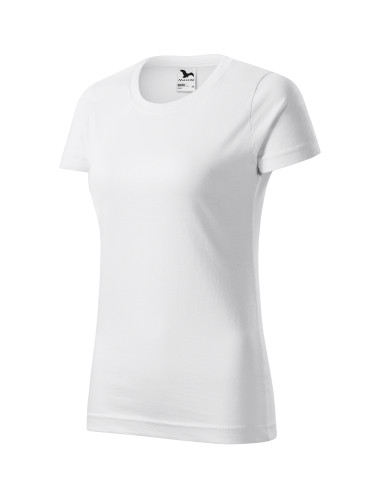
Women's T-shirt with a fitted cut, 100% cotton, 160 g/m², perfect for embroidery or logo printing.
PLN 15.79 gross
See product → |
Where to place the logo? Proven print and embroidery layouts
The placement of the logo on a T-shirt is crucial to the visual effect. Poor proportions or a poorly thought-out layout can ruin even the best design. Here are the proven patterns.
Layout 1: Polo / shirt – logo on the chest (left side)
- Technique: computer embroidery
- Width: 6–8 cm
- Application: office wear, reception, sales
- Optional: employee name under the logo (embroidery)
Layout 2: Company T-shirt – small logo on the front + large on the back
- Front: left chest, 8–10 cm wide (embroidery or print)
- Back: 25–30 cm wide (DTF print or screen printing)
- Application: service, construction, assembly workers – large logo on the back is visible from far
- Optional: phone number or website address below the logo on the back
Layout 3: Event T-shirt – main logo + sponsor logos
- Front/back: main event logo
- Sleeves: sponsor logos (max. 8–10 cm wide)
- Application: trade fairs, conferences, sporting events
Layout 4: Work T-shirt – large logo on the back + small on the front
- Back: maximum visibility, 25–30 cm
- Front: small logo on the chest
- Application: employees without direct customer contact
The rule of thumb: Don't overdo it with the number of elements. Less is more. One logo on the chest and possibly another on the back is perfectly sufficient. An overloaded t-shirt looks unprofessional and loses its legibility.
Our clients receive a visualization before production – you can see how the logo will look on the selected model before we start sewing or embroidery. This is a standard part of the process at P&M.
How to design and order corporate t-shirts – step by step
The process of ordering corporate t-shirts with a logo is simpler than you think. Here are 6 steps that will take you from idea to finished t-shirts. A detailed description of the entire process can be found in our comprehensive guide: how to order clothing with embroidery or print.
Step 1: Choose a design and branding technique Decide which T-shirt design suits your industry (use the table above) and which technique you want to use for branding your logo. Not sure what to choose? P&M will advise you based on your budget, cost, and desired effect.
Step 2: Prepare the logo file
- Format: PNG with transparency (background)
- Colors: RGB
- Resolution: min. 1000 px for a small logo (chest), min. 3000 px for a large logo (back)
- P&M also accepts the following formats: .cdr, .eps, .ai, .pdf
Step 3: Determine the layout and sizing Determine where the logo should appear (front, back, sleeves) and in what size. Gather a team size chart – P&M will help you choose the right proportions.
Step 4: Request a visualization and sample Before production begins, you will receive a visualization of the design. You can also order a physical sample – P&M produces samples before the entire run is completed. This is the easiest way to avoid errors.
Step 5: Approve and set a deadline Standard turnaround time: 10 business days for printing, 14 days for embroidery. Once the visualization is approved, production begins.
Step 6: Receive your finished t-shirts P&M packs your order according to your specifications – you can order shipping to multiple addresses, custom packaging, or even shipping to InPost parcel lockers.
Common mistakes when ordering corporate t-shirts (and how to avoid them)
What to watch out for: The following mistakes are the most common reasons for complaints in the corporate apparel industry. Each of them is easy to avoid – you just need to know the rules.
Mistake 1: Logo resolution too low Result: blurry, pixelated print. How to avoid: Prepare your logo at a minimum resolution of 1000 px (small logo) or 3000 px (large logo). P&M checks files before production and notifies you if the quality is insufficient.
Mistake 2: Lack of transparency in the file Effect: White background around the logo – looks unsightly, especially on colored T-shirts. How to avoid: Save the logo in PNG with transparency (alpha channel). P&M also accepts .cdr, .eps, .ai, and .pdf.
Mistake 3: Logo in CMYK instead of RGB Effect: Distorted, faded colors on the print. How to avoid: Use RGB for digital prints (DTG, DTF). CMYK is for offset printing – it will produce a poorer result on a T-shirt.
Mistake 4: Excessive number of elements Effect: Chaos, illegibility, unprofessional appearance. How to avoid: Stick to the golden rule of thumb – a maximum of two elements (front + back). Only use a logo on the sleeve if necessary (e.g., sponsors at an event).
Mistake 5: Choosing the wrong technique for the material Effect: Embroidery on a thin t-shirt (140 g/m²) can deform the material. DTG printing on polyester will not cure properly. How to avoid: P&M recommends against embroidery on thin t-shirts and rainwear. For thin materials, they recommend DTF – it works on any surface.
Mistake 6: Not having a sample before producing the entire run Effect: Only after receiving 100 t-shirts do you realize that the logo is too small, the color is wrong, and the layout doesn't look the same as on the screen. How to avoid: Always order a sample. P&M makes samples before implementation – this is standard, not an optional extra.
Corporate T-shirts and Taxes – What You Should Know
Expenditures on company apparel with a logo (both the product and branding) are 100% deductible. This translates into real savings for your company.
Calculation example:
- 100 T-shirts × PLN 30 net = PLN 3,000
- At a 19% tax rate: the actual savings are PLN 570
- At a 32% tax rate: the savings reach PLN 960
In other words, the actual investment cost is lower by the amount of tax you would pay on this sum. Corporate apparel with a logo isn't an expense – it's a tax-deductible expense that also boosts your brand recognition.
P&M issues VAT invoices with deferred payment terms – including for public institutions. As a company with 30 years of experience in the Polish market, we meet all formal requirements for state and local government orders.
FAQ – Frequently Asked Questions about Corporate T-shirts with Logos
You can find more answers to your questions in our FAQ section.
What is the minimum order quantity? From 1 piece – we offer DTG, DTF, and computer embroidery services starting from just one piece. Screen printing is cost-effective for orders of 50+ pieces.
How long does it take to process an order? Standard time is 10 business days for printing (DTG, DTF, screen printing) and 14 days for computer embroidery.
Can I order a sample before production? Yes. P&M produces samples before the entire run is completed – this is a standard procedure that eliminates the risk of errors.
Can I combine sizes in one order? Yes. You can freely mix sizes and colors within a single order.
How to wash company t-shirts? Wash inside out, at up to 40°C, without bleach. Do not tumble dry – the print and embroidery will then last much longer.
How many washes will the print/embroidery last?
- Computer embroidery: indefinite – more durable than fabric
- DTF: 60+ washes
- DTG: 50+ washes
- Screen printing: 50+ washes
Can I add employee names? Yes. We personalize names with embroidery or print – most often on the chest or sleeve.
What about complaints? P&M is responsible for manufacturing errors. If the product differs from the approved visualization, we will exchange it or refund the purchase price.
Can personalized clothing be returned? No, unless there is a product defect or a manufacturing error. Therefore, it is crucial to approve the visualization and sample before production.
What file formats do you accept? PNG (with transparency), .cdr, .eps, .ai, .pdf. Color scheme: RGB.
Pre-order checklist
Before placing your order, please review the checklist below. Every checkbox you check off means one less mistake.
- ✅ I chose a model tailored to the industry (a polo shirt for the office, a premium T-shirt for a service, a basic one for an event)
- ✅ I decided: embroidery or print (embroidery = prestige and durability, DTF = graphic flexibility, screen printing = large print runs)
- ✅ I prepared a logo in PNG with transparency (min. 1000 px for a small logo, 3000 px for a large one)
- ✅ I determined the layout (front / back / sleeves) with specific dimensions
- ✅ I determined the team's sizing
- ✅ I requested a visualization of the design
- ✅ I ordered a sample before the entire run was produced
- ✅ I set a deadline for completion (10 days for printing, 14 days for embroidery)
- ✅ I checked the possibility of including the expense as a BUY
- ✅ I know the care instructions (left side, 40°C, no dryer)
Contact P&M – we will help you through every step. As a manufacturer with our own sewing room (since 1996) and embroidery studio (since 2008), we process orders from 1 to 500+ pieces, advise on the selection of techniques and models, and provide visualizations and samples before production. 30 years of experience and a 5.0/5 rating on Google (185 reviews) speak for themselves.
Comments (0)